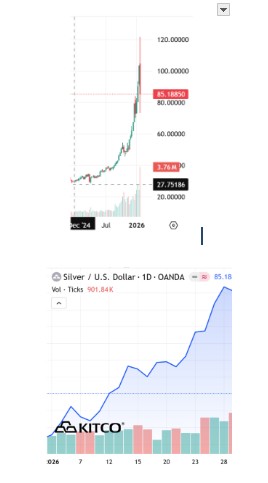
I mentioned before the holidays that I’d put some money into silver. Over the course of last year, its price surged from around US$27.50 per ounce to roughly US$70 by year’s end — an extraordinary and historically unusual run.
Then, in the space of just four weeks, silver climbed again from US$70 to over US$120 per ounce. A further 70 per cent gain in a month.
I’ll admit, I briefly entertained some wildly optimistic thoughts — including whether the next 1Group offsite might be hosted on our very own island somewhere off the Australian coast. Tasmania started to look surprisingly attractive.
Reality arrived swiftly. From Thursday to Saturday, silver fell around 30 per cent, back to roughly US$85 per ounce. Ce la vie.
Why did silver soar? Partly due to a broader shift away from fiat currency — an abstract system — toward tangible assets like precious metals, property, and real businesses. But the sharper move was driven by something far more familiar: momentum chasing. The “get rich quick” mentality amplified by impatience, social media, and the belief that trends only move in one direction.
“The trend is your friend,” as the saying goes — until it isn’t.
This is where the analogy matters for property.
We are seeing stronger clearance rates, but not indiscriminate buying. Activity is concentrated where affordability still stacks up. Buyers are cautious, strategic, and far less willing to stretch simply to be part of the crowd. As a result, median prices can soften even while transaction volumes improve.
That’s not weakness. It’s maturity.
As Dave Ramsey often points out, becoming a multi-millionaire isn’t about brilliance or luck. It’s about time and disciplined investing. His preferred vehicle is diversified equities. Assuming an 8 per cent annual return, investing $100 per month over 30 years compounds to roughly $150,000. That’s not optimism — it’s maths.
For many of our clients, however, property simply fits life better.
Busy professionals and business owners don’t always have the bandwidth to actively manage portfolios or time markets. Property introduces forced discipline through regular mortgage payments, benefits from leverage, offers tax efficiency, generates growing rental income, and historically delivers strong total returns when selected well.
Once the right asset is acquired, the investment largely runs itself.
The lesson of silver isn’t that risk should be avoided — it’s that momentum without fundamentals is fragile. The same applies to property.
Long-term wealth is built through orderly decision-making, not speculation. The key risk isn’t market volatility; it’s making poor asset selections driven by emotion, fear of missing out, or short-term narratives.
If the most important decision is which property to buy — and when — that’s exactly where independent advice, strategy, and due diligence matter most.
There’s no secret formula to sustainable wealth creation through property. There is, however, a disciplined process — and that’s where we help our clients stay on the right side of the trend, long after the hype fades.