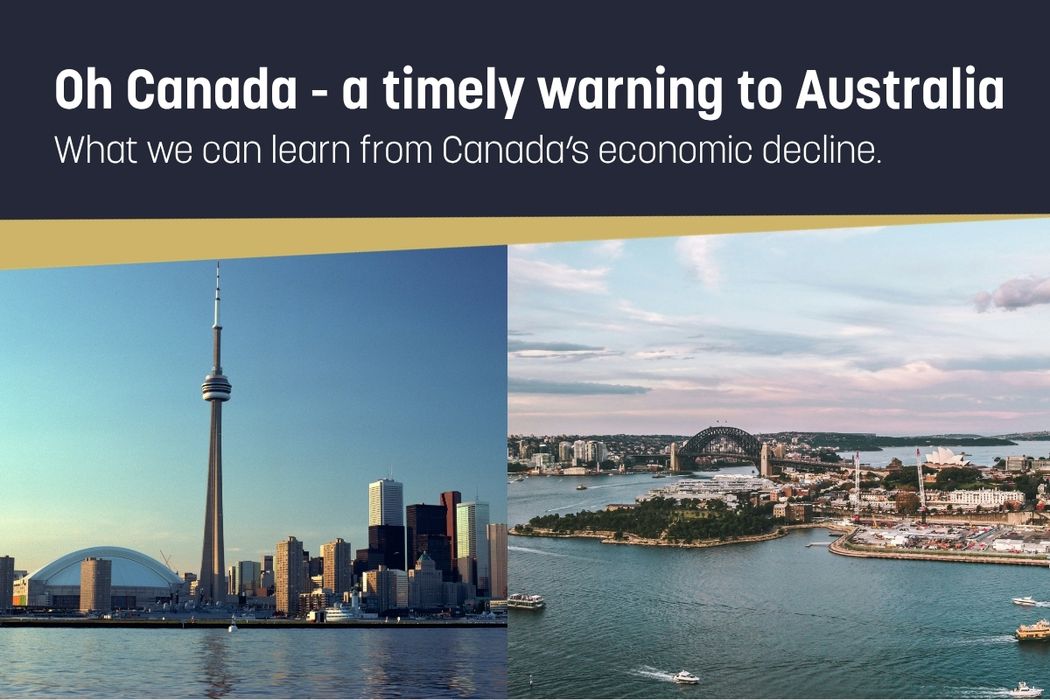
Canada’s recent economic decline should be viewed as a warning sign for Australia. The similarities between the two countries are too close to ignore. Both have become increasingly reliant on housing and government-led activity, while productive business investment has weakened. Over time, that mix erodes productivity, slows income growth and puts pressure on living standards.
The policy solution is not complicated, even if it is politically difficult. Australia needs bolder tax reform, lower regulatory friction and stronger incentives for capital to flow into productive enterprise rather than simply into land and existing housing stock. Until that changes, property is likely to remain the dominant engine of wealth creation and, for many Australians, still the most reliable path to financial security.
Canada was long seen as one of the world’s great success stories — wealthy, stable and highly liveable. But over the past decade, its position has weakened. Beneath the surface, the issue is not simply cyclical softness. It is structural.
Too much capital has been directed into housing, while too little has gone into productive investment. That matters because productivity is what ultimately drives real wage growth and rising living standards. If an economy does not produce more, it cannot sustainably pay more.
Canada’s productivity growth has effectively stalled. Business investment has been weak, capital intensity has declined and housing has become the dominant investment class. The result is predictable: wages have struggled to keep pace, even as the cost of living — particularly housing — has continued to rise.
This does not create an obvious collapse overnight. In fact, that is what makes it dangerous. Employment can remain relatively firm. Participation can stay high. Headline economic data can look stable enough. But underneath, the middle class slowly loses ground. Households find it harder to accumulate wealth, improve their financial position or feel that they are moving forward.
That is the real warning. Decline in living standards does not always arrive dramatically. More often, it arrives gradually — through stagnation.
Australia is not there yet, but it is moving in the same direction.
The key difference is that Australia has, for now, been supported by the strength of the resources sector. That has helped cushion the economy and keep national income stronger than it otherwise would be. But the broader structural pattern is increasingly familiar. Capital is flowing disproportionately into residential property. Housing supply remains constrained, especially in major cities. As a result, housing costs continue to rise faster than incomes.
The economic chain is straightforward:
Productivity growth → wage growth → real income → housing affordability.
In Canada, that chain has already broken at the first link. In Australia, it is under growing strain.
Why does this happen? Because prosperous economies are built on production. Real wage growth comes from producing more goods, more services and better outcomes with the same or fewer inputs. That requires capital to flow into businesses, technology and innovation. It requires lower regulatory hurdles and a system that rewards enterprise.
When too much capital is funnelled into non-productive assets — whether that is existing housing stock or ever-expanding government expenditure — less is available for the businesses that actually lift productivity. Over time, that weakens the economy’s ability to generate genuine income growth.
Canada, and to some extent the UK, appear further advanced in this cycle: housing-led growth, heavy government influence and weaker productivity. Australia shares many of the same characteristics, even if the mining sector has delayed the full impact. Without meaningful reform, the long-term direction is likely to be similar — slower growth in real incomes and a gradual deterioration in living standards.
From a property perspective, this creates an important implication.
In Australia, affordability is increasingly becoming the main driver of price growth, rather than pure desirability. That is why we are seeing stronger performance in more affordable corridors, while premium markets can remain sluggish for longer. It also means that future price growth may rely more heavily on population growth and migration, particularly in supply-constrained cities.
At the same time, it is worth asking why property continues to dominate as the investment of choice. The answer is not mysterious. Property benefits from relatively low borrowing costs, the ability to gear efficiently and favourable tax settings. In a system like that, it is no surprise that capital continues to flow into housing.
One day, policy settings may shift and other asset classes may become more attractive. Productive business ownership may again be rewarded more meaningfully. But until that day comes, the reality remains the same: regardless of the broader economic distortion it may create, property is still one of the most effective paths to long-term wealth creation in Australia.
Canada offers a glimpse of what happens when an economy leans too far into housing and away from production. Australia should take note.
The warning is there.
The question is whether policymakers act on it — and until they do, investors need to deal with the world as it is, not as it should be.